


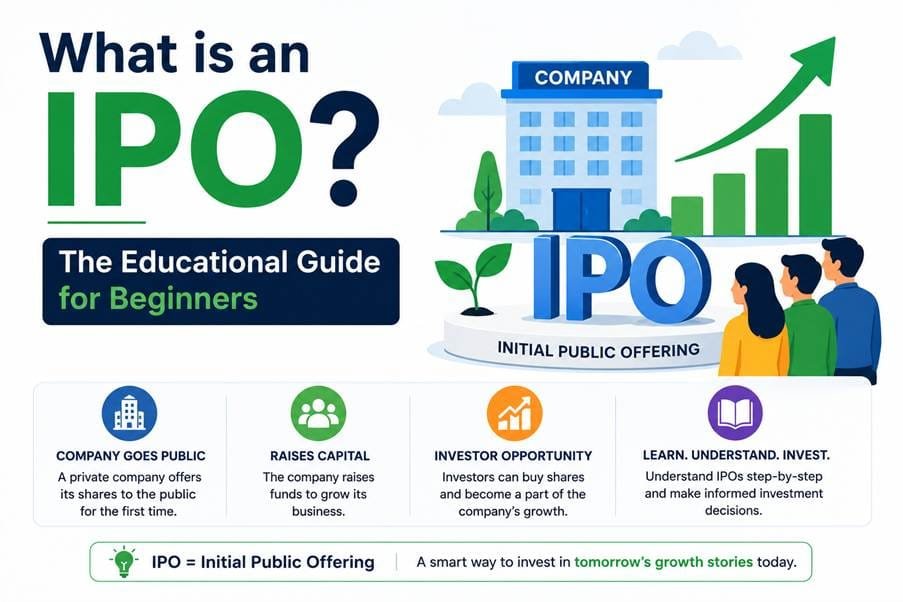
An IPO, or Initial Public Offering, is the process through which a privately held company issues shares of stock to the general public for the very first time. By transitioning from a private entity to a publicly traded stock on exchanges like the NSE or BSE, the company raises capital from retail and institutional investors. In exchange, these investors receive partial ownership of the business and the opportunity to profit from its future growth. You also need to understand IPO GMP with it.
Demystifying the Initial Public Offering (IPO)
For decades, the stock market has been one of the greatest wealth-creation engines in human history. But before a stock can be traded daily by millions of people, it must make its debut. That debut is the Initial Public Offering.
When a startup or a private family business is first established, it is usually funded by the founders, their friends and family, or private venture capitalists. As the business grows, its ambitions expand. It might want to build new factories, pay off existing debt, or expand internationally. However, private funding has its limits.
To unlock massive amounts of capital, the company decides to open its doors to the public. It divides its total value into millions of tiny pieces—called shares—and sells them to everyday investors. The moment the opening bell rings on listing day, the company transforms from private to public, bringing a whole new level of regulatory scrutiny, financial transparency, and market excitement.
How an IPO Actually Works: The Step-by-Step Journey
Going public is not an overnight process. It requires months of preparation, legal filings, and marketing. Here is the step-by-step lifecycle of how a company officially hits the stock market:
1. Hiring the Underwriters (Investment Banks)
A company cannot just walk up to the stock exchange and ask to be listed. They must hire investment banks—often referred to as Lead Managers or Underwriters. These financial experts evaluate the company’s financials, help determine the initial value of the business, and guarantee that the shares will be sold to the public.
2. Filing the DRHP (Draft Red Herring Prospectus)
Transparency is the bedrock of the public markets. The company and its underwriters must draft a massive document called the DRHP and submit it to the Securities and Exchange Board of India (SEBI). This document is essentially the company’s autobiography. It details its business model, revenue, outstanding debts, legal risks, and exactly what it plans to do with the IPO money.
3. SEBI Approval and Marketing
Once SEBI reviews the DRHP and ensures all disclosures are accurate, the company gets the green light. The management team then goes on a “roadshow.” They travel across the country (or virtually) pitching the company to large institutional investors to drum up excitement and secure early financial commitments.
4. Setting the Price Band and The Bidding Process
The company will announce a price band—for example, ₹100 to ₹105 per share. Retail and institutional investors are then given a specific window (usually 3 to 4 days) to apply for shares at a price within that band. This is the subscription phase.
5. Allotment and Listing Day
If the demand is incredibly high (oversubscribed), shares are distributed through a lottery system. If you are lucky enough to win the lottery, the shares are credited to your Demat account. A few days later, the stock officially lists on the exchange. Depending on market demand, it might list higher than the issue price (a listing gain) or lower (a listing discount).
Why Do Companies Go Public?
It takes a lot of time, money, and regulatory headaches to go public. So why do companies do it? The motivations usually boil down to three key factors:
- Raising Capital for Expansion: The primary reason is to secure a massive influx of cash. This money is often used for aggressive expansion, research and development, or acquiring competitors.
- Providing an Exit for Early Investors: Venture capitalists and angel investors who funded the company in its early days want a return on their investment. An IPO allows them to sell their private shares to the public at a massive profit.
- Brand Prestige and Trust: Public companies are subject to strict financial audits and regulations. Because of this transparency, they often command more trust from consumers, lenders, and global business partners.
Understanding the Key Players in an IPO
When you look at an IPO subscription data chart on a platform like IPOIndex.in, you will notice the allocation is divided into specific categories. Understanding these players is crucial for gauging market sentiment.
- Qualified Institutional Buyers (QIBs): These are the heavyweights. Mutual funds, insurance companies, and foreign portfolio investors fall into this bucket. They have massive capital and deep research teams. If QIBs are aggressively bidding, it is usually a sign of fundamental strength.
- Non-Institutional Investors (NIIs): Also known as High Net-Worth Individuals (HNIs). These are wealthy individuals or corporate bodies bidding for more than ₹2 Lakhs worth of shares. They often rely on grey market trends and short-term financing to boost their applications.
- Retail Individual Investors (RIIs): This is the category for the everyday investor. Anyone applying for shares worth less than ₹2 Lakhs falls here. SEBI mandates that a certain percentage of every IPO must be reserved for retail investors to ensure fair wealth distribution.
How to Evaluate an IPO Before Investing
Investing in an IPO based purely on hype is a recipe for disaster. Before locking in your capital, you need to conduct a fundamental analysis. Here is how you can separate the winners from the wealth-destroyers.
Read the Objective of the Issue
Why is the company raising money? If the capital is going toward paying off old debts or cashing out the founders (known as an Offer for Sale or OFS), it is less attractive. You want to see the money being used for fresh growth, capital expenditure, and future expansion.
Analyze the Valuations
A great company can still be a terrible investment if it is overpriced. Look at the company’s Price-to-Earnings (P/E) ratio and compare it to its publicly listed competitors. If an upcoming footwear brand is demanding a P/E of 80, while the industry leader trades at a P/E of 40, the IPO is likely overvalued.
Check the Grey Market Premium (GMP)
While not officially regulated, the IPO GMP serves as a highly accurate real-time sentiment tracker. By checking reliable platforms like IPOIndex.in, you can see what the informal market is willing to pay for the shares before listing. A consistently high GMP often indicates strong market demand and potential listing gains.
The Inherent Risks of IPO Investing
It is crucial to understand that IPOs are not guaranteed money-makers. They carry unique risks that are different from buying already-established stocks.
- Lack of Historical Data: Unlike companies that have been listed for twenty years, newly public companies do not have a long track record of how they behave under public scrutiny or during economic downturns.
- Overpricing Traps: Investment banks are hired by the company, meaning their goal is to get the highest price possible for the shares. Sometimes, the initial hype justifies the price, but once the hype fades, the stock can crash significantly.
- Post-Listing Volatility: The first few months of a newly listed stock are notoriously volatile as early investors take their profits and the market struggles to find the true, fair value of the shares.
Conclusion
Understanding the mechanics of an IPO is a foundational skill for any modern investor. It is the bridge between private innovation and public wealth creation. By learning how to analyze a DRHP, understanding the motivations of the underwriters, and tracking market sentiment, you elevate yourself from a casual gambler to a strategic investor.
The primary market moves incredibly fast, but armed with the right educational foundation, you can navigate it with confidence. Stop relying on luck, and start relying on data, research, and proven market principles.
Want to put your new knowledge into action? Head over to IPOIndex.in to track live subscription statuses, review upcoming company profiles, and monitor real-time GMP trends. If you have any questions about how the IPO allotment process works, drop them in the comments below!
Disclaimer: This article is for educational and informational purposes only and should not be considered financial or investment advice. Readers should do their own research before making any investment decisions. We are not responsible for any financial losses based on this content.